A Sensational History
In 1605, Johann Carolus’s Relation aller Fürnemmen und gedenckwürdigen Historien (Account of All Distinguished and Commemorable News) was released from the press. For the first time, the printed paper arrived at the doorsteps of German citizens, marking a momentous shift in the relaying of information. No longer was the news solely distributed by word of mouth or public announcements, and people could now physically keep up with their community, country, and the world for a small subscription fee—and, thus, the world of journalism was born. Reporting the known to the unknowing became a commonplace career as the printing press took hold over the globe.
With a growing industry, however, comes competition… and for journalism, vying for the top sales appeared in the form of sensationalism.

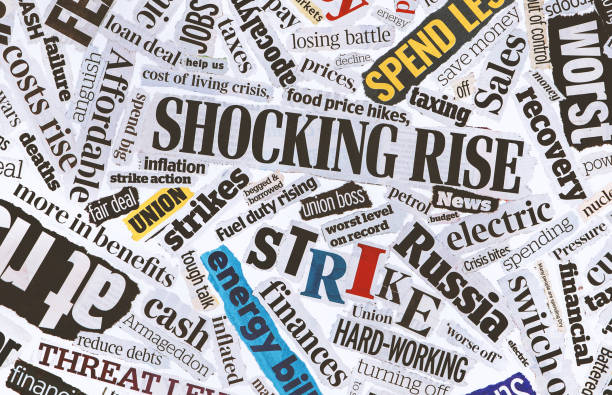
Sensationalism, a close synonym of hyperbole, is the exaggerating of stories or language at the expense of accuracy. It’s a classic attempt to attract an audience by being the most “fun” or “interesting” outlet. At first, it came in the form of cheap tabloids such as the American “Penny Press” (Benjamin Day’s The Sun) and the infamous Yellow Journalism trend (William Randolf Hearst’s New York Journal and Joseph Pulitzer’s World) of the 19th century, both of which marketed misinformation and scandal to working class audiences. In a world where journalistic integrity was a fledgling concept, sensationalism thrived: “It is the Journal’s policy to engage brains as well as to get the news, for the public is even more fond of entertainment than it is of information,” quoted a New York Journal editorial in 1896.
As the paper began to share its monopoly with the radio in the 20th century, sensationalism only became more commonplace alongside the production of dramatized shows featuring celebrity and political misconduct, true crime, and coverage during wartime. Programs such as The March of Time (1931-1945) stretched real stories into blurred, entertaining chronicles of Great Depression and World War II era events. A national panic was even stirred in 1938, when Orson Welles’s The War of the Worlds production convinced listeners that a genuine alien invasion had begun.
From there, television (and, later, the internet) continued the same trend: channels with politically charged scripts, state sponsoring, and unverified or AI-generated content take up a growing proportion of news outlets.
Breaking News! … Maybe?
So… what’s the big deal?
As sensationalism has progressed, misinformation has proven to be more and more detrimental to the public. Conspiracy, exploitation, stigmatization, and undue fear are all cited as major criticisms of a sensationalist media space. From false interpretations of statistics to overly political exaggeration, facts can be lost in the static—and, as television, social media spaces, and digital journalism have all but begun to replace paper and radio broadcasting, the press can move too quickly for us to separate reality from fiction.
Additionally, when reported events are skewed or outright unfactual for the benefit of entertainment, harm can quickly find the documented party: “Because of [the] constant bombardment of stories symbolizing fear in the news, people begin to associate the subject of those stories (oceans and shark attacks are an example) with fear,” stated William B. Frye, a West Virginia University Masters of Science in Journalism student, in his graduate thesis. “The media [has] the ability to influence what the readers think … constant coverage … eventually [leads] the audience to feel scared or panicky every time they think of the topic at hand.”

In the event of journalistic coverage pushing readers away from a concerning subject, the audience’s preconceptions or misinformed notions can become the commonplace belief (like the overblown fear of sharks in the ocean, as Frye discussed) in a psychological fallacy called an availability heuristic. Alternatively, something trivial can become wholly bombastic by the hand of a similar issue: if reporters sensationalize something unduly (a rumor, a scientific finding, a number, etc.) the problem becomes that people might fear something that shouldn’t be a concern at all.
With the aforementioned extensive history of sensationalism, none of this is new. But, with recent sociopolitical tensions and the continued rapid incline in social media usage, it’s becoming impossible to avoid. Everywhere we look on the internet, we’re met with “Breaking News!”, clickbait headlines, or non-credible outlets (such as TikTok’s short-form content, YouTube videos, or Instagram/Facebook posts, which are almost wholly unregulated and free to use unverified sources), which further exaggerate or blur sensitive issues—and according to the Pew Research Center, approximately 53% of U.S. adults get at least some of their news from social media in 2026. Aside from that, only 56% have much trust in verified national news outlets in 2026, down 11% from 2025, which doesn’t assert much confidence in social media’s “credible” alternative.
Information, both consequential and not, is vulnerable to dramaticism… and when that happens—when we feel we can’t even trust the supposedly trustworthy—what can we believe?
Finding the Facts in a Sensationalist Space
What do we do in a world where we don’t know what’s true? How do we sift through the inherent theatrics that can come with journalism and divulge reality? A simple Google search will recommend for you to simply stop digesting social media content, which, while a well-intentioned suggestion, isn’t all that helpful: having a social media account, which is almost vital to stay connected with the modern world, tends to thrust news topics at you whether you want it to or not. Plus, social media isn’t the only instigator of sensationalist tendencies. Television outlets, lingering newspapers, and online articles can be just as much to blame.
A better solution to dramatization is far more simple: research.
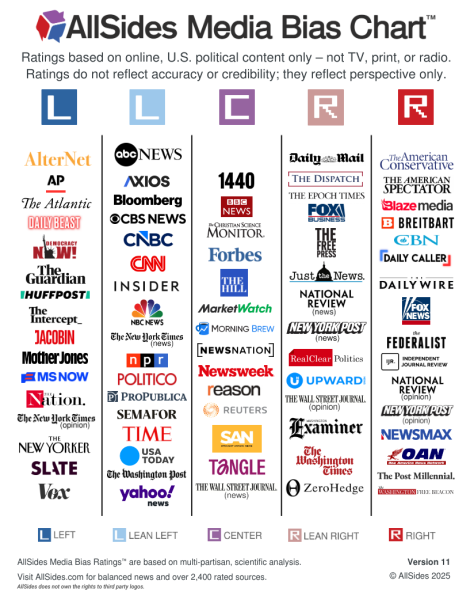
If something seems too outrageous to be real, it likely is. This goes for any outlet: if you encounter a headline, post, or article which doesn’t sit quite right, do your own research. The benefit of an infinite media is that among the sensation, the facts do remain, and with your own sleuthing, unaltered accounts and truthful chronicles will emerge. Credible websites, stations, and posts tend to present their sources, credentials, peer reviews, and reputation readily. Additionally, in the case of larger outlets, independent resources such as the Ad Fontes Media Bias Chart and the AllSides Media Bias Chart exist to alert users to political and reliability standings so they can judge for themselves the trustworthiness of presented information.
With all the grief that sensationalism causes—the misinformation, the unrest, and the influence—the monster is manageable by consumers becoming knowledgeable. Media literacy is the greatest combatant to incorrect information.
So, the next time you’re confronted with the grand parade of sensationalized news, stay calm in the face of a report that wishes to provoke you. Take the autonomy to discover reality for yourself. Do not let the wild world of journalism tell you what to believe, inform yourself and draw your own conclusions, and, most importantly, do not let everything become the extreme.
—
Source List (ordered by mention)
Information on the Relation aller Fürnemmen und gedenckwürdigen Historien | UPENN Library
Information on the United States “Penny Press” | First Coast News
Information on Yellow Journalism | history.state.gov
March of Time reflection | nyhistory.org
War of the Worlds reflection | history.com
“A qualitative analysis of sensationalism in media” | WVU
Availability heuristic definition | APA Dictionary
Clickbait definition | Merriam Webster Dictionary
Journalism fact sheet | Pew Research Center
How much do Americans trust information from the news? | Pew Research Center
Evaluating sources | Harvard College
Editor’s note: All sources in this list are free use for research purposes.