Mark Twain once said, “There are two types of speakers: those who get nervous and those who are liars.” Sweaty palms, shaky breathing, and a pounding heartbeat all seem to support this claim, and “stage fright” is a term that many of us know all too well. Nonetheless, public speaking is a skill needed in most team-based environments, especially when entering the career field. So, how does Woodford County High School teach this essential ability?
A quick jog down the Career and Technical Education hallway gives one clear example. This semester, every student enrolled in an Agriculture Education class was required to present a three to five-minute speech on a topic assigned to their class. While a general outline is provided, all of the information, writing, and personal reflections within the speeches come directly from the students themselves.
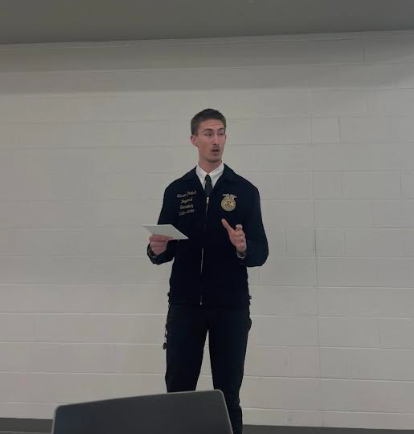
They spend about two full class blocks researching, writing, and practicing, and a final class block delivering their speeches in front of classmates and their agriculture teacher. For the especially nervous students, video submissions are available, but with an emphasis on body language and delivery in the rubric, most opt for the in-person presentation.
About 85% of people report feeling anxious about public speaking in their lives, according to WorldMetrics. While one speech in the classroom isn’t a perfect solution, it’s a measurable attempt to get high school students more comfortable with expressing their thoughts and opinions—and the efforts of the agriculture department haven’t gone unnoticed.
Emerson Probus, a junior and third-year agriculture student, reflected, “The assignment shows students that public speaking isn’t necessarily something that they need to be afraid of, and that they have teachers who are willing to support them through the process.”
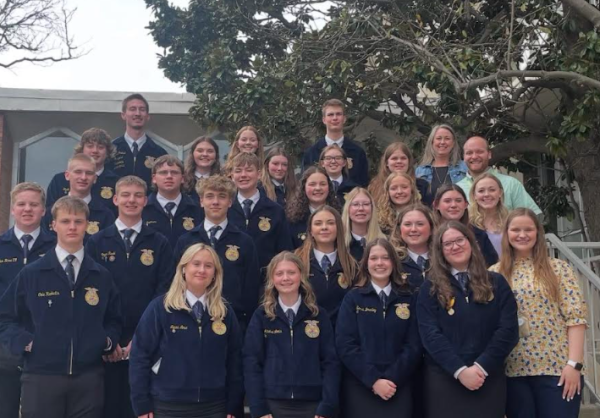
Agriculture classes even have a unique opportunity to celebrate the accomplishments of students after their public speaking mini-unit is complete. Mrs. Probst and Mr. Richardson (the WCHS agriculture educators) assign topics to their classes based on the Kentucky FFA Public Speaking categories for the year. This ensures that the speeches are directly related to what students are learning about in their classes and what the major agricultural issues are in each industry. Students who are interested in going further with public speaking are able to take their classroom speeches and use them in FFA Public Speaking contests, without needing to change content or write entirely new pieces.
For many students, this level of participation is daunting, but for some, it’s the perfect push. Robin Rhea is a second-year FFA member and current junior whose first ever competition was because of the public speaking requirement in his Small Animal class. His “Small Animal: Reproduction and Genetics” speech was originally meant to be nothing more than a summative grade.
However, after presenting to the class, he chose to go the extra mile and try to compete. “I figured since I had put so much work into it and I did want to compete that year, I figured it would be a great way to do it…I focused on how genetics play a role in breeding and why we purchase certain dogs. I talked about bulldogs, their respiratory issues, and how those stem from genetic malpractice and what could be improved through specific reading.”
Rhea practiced his speech, researched background information, and meticulously prepared for any questions the judges might ask at the Regional Contest Day. He reflected, “Whenever you’re doing your research, that’s what’s going to help you formulate an opinion and gauge how you want to attack the speech. So I’d say apart from public speaking, you gain that skill of research and being able to make an argument from your own knowledge.” While he didn’t advance past Regions, with Small Animal being a competitive area and only the top two moving on, it lit a flame.
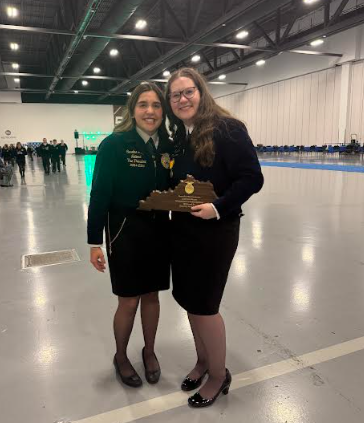
He went on with a new passion for public speaking, all because of one classroom commitment. This year, he dedicated himself to the Vet Science CDE, taking his motivation from the previous year and pouring it into a brand new contest. His efforts paid off in a significant way- Woodford County was the runner-up team in the state, and Rhea secured second place individually, out of 156 competitors.
The speaking requirement goes beyond being a simple video or exercise for students. It teaches necessary and marketable skills to the over 400 students enrolled in agricultural education at Woodford County High School.
A study by the Journal of Youth Development found that public speaking improved “confidence, communication skills, and research abilities” in students ages 9 to 17. Those abilities will play a major role in the success of our Woodford County students as they enter the real world. For many, they likely already play a factor in their internships, part-time jobs, and extracurriculars.
Probus explained, “The public speaking requirement has improved my public speaking skills by giving me a space to practice without the fear of being judged. Even though it’s a requirement, the ag teachers are so supportive in the speech process. They will check your work, help you generate ideas, and listen without making you nervous.”
Mark Twain’s comment about every speaker being nervous resonates with most people as a universal truth. Your hands will probably always shake a little bit before standing in front of a group, and a quickening heart rate is a perfectly normal reaction to holding speech cards in your hands. Nonetheless, the ability to speak concisely and with a well-informed background is essential for functioning wherever life takes you.
Clearly, our agriculture department understands this very well, but where can we find ways to introduce this in the other classrooms across our school? Where can we emphasize the importance of WCPS students practicing these abilities?
Increasing the self-confidence of our young scholars is a task only possible with the collaboration of our entire community. As we continue through the coming semester, I challenge every student to find a way to step (even only slightly!) beyond their comfort zone.
Whether it’s a contest, a presentation in English, or even taking charge of a group project, find ways to challenge both yourselves and your teachers as you prepare for the next phases of high school, college, and beyond.