
The classic tale of Romeo and Juliet has been told for ages; it’s the first Shakespeare play most people learn of, and the most popular play by far. However, just because it’s popular does not mean it’s naturally good. There is, potentially, another play that could rival Romeo: Macbeth. The tragedy of Macbeth revolves around the titular character’s ambition, rise to power, and eventual fall. It’s an amazing tale of revenge and foretold power, but does it compare to the compelling love story of Romeo and Juliet? This article will compare and contrast the two plays and ask: Should Romeo and Juliet be replaced with Macbeth in English classes? As the writer, I am biased towards Macbeth, but I will provide as much evidence as possible for both sides.
Romeo and Juliet
You have heard the tale many times before: Two star-crossed lovers try to get together despite their families’ hatred for one another. It’s a simple premise, and there’s little to dig into when it comes to depth and analysis. That, however, is a two-sided coin. It’s easier for new readers to get into this new style of writing, but because it’s so simple, the story lacks engagement beyond the beginning. Lena Clayton, a sophomore, said, “The overall vibe of it was, like, lovey-dovey but not that serious or ‘literary.’ Although, I feel like the way it was written helped and gave a better portrayal of deeper emotions. Romeo and Juliet is a very mainstream play, and it’s a pop culture thing at this point. It was a unit because you expect to read it in high school.” Romeo and Juliet is by no means bad, but Clayton did put it correctly: it’s very mainstream, and you almost always expect it.
Macbeth
I could rant about Macbeth for days, but for the sake of this article, I will summarize it into a few key points: Macbeth replacing Romeo and Juliet would not only bring something new and unexpected, but also a story with more challenges to analyze and interpret. From my own personal experience with Macbeth, the story is complex and would require students to learn a basic understanding of Shakespeare’s plays, but with the advantage that it provides more examples of the morality and symbolism of his plays. The disadvantages are a tad demoralizing, though. Macbeth’s story is hard to get into for a beginner, and it would require more dedication from students compared to Romeo and Juliet. The messages might also be lost in the language, which English II students may be unfamiliar with. Macbeth would be a harder story to start, but it would pay off in the long run, as students get an immediate sense of Shakespearean plays.
Conclusion(?)
As the writer, both teaching choices are fine by me, as both stories are equally plausible options. Romeo and Juliet is an easier-to-understand, more recognizable story that every student and their mothers know of. But Macbeth is a harder tale to get started with, although it eventually pays off with an engaging plot with plenty to analyze. Which story you prefer is up to you, but I hope (eventually) the English department might set its sights on a new play.
Should Romeo & Juliet be replaced with Macbeth for English II?
Two Shakespearean works duel to figure out which is better for the classroom.
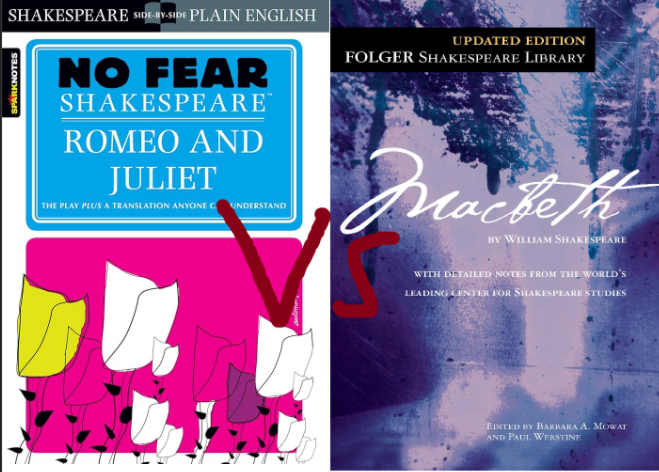
Romeo and Juliet No Fear version with a drawn “VS” over it, with the Updated Macbeth version on the right
More to Discover






About the Contributor

Jackson Pinks, Co Editor-in-Chief
Jackson R. Pinks is a WCHS Senior, and this is his third year working for the Jacket Journal. He was previously the A&E Editor but is now the Co-Editor-in-Chief, working with Kate Rannenberg. He hopes to create a lasting impact on the publication. He is a large fan of creative writing and reading, with his favorite series being the Stormlight Archive. His favorite color is pink, and he is absolutely a cat person. His hobbies include playing games, writing creative pieces for fun, and reading in his off-time. He wants to become an editor for Tor Fantasy after he graduates from college.