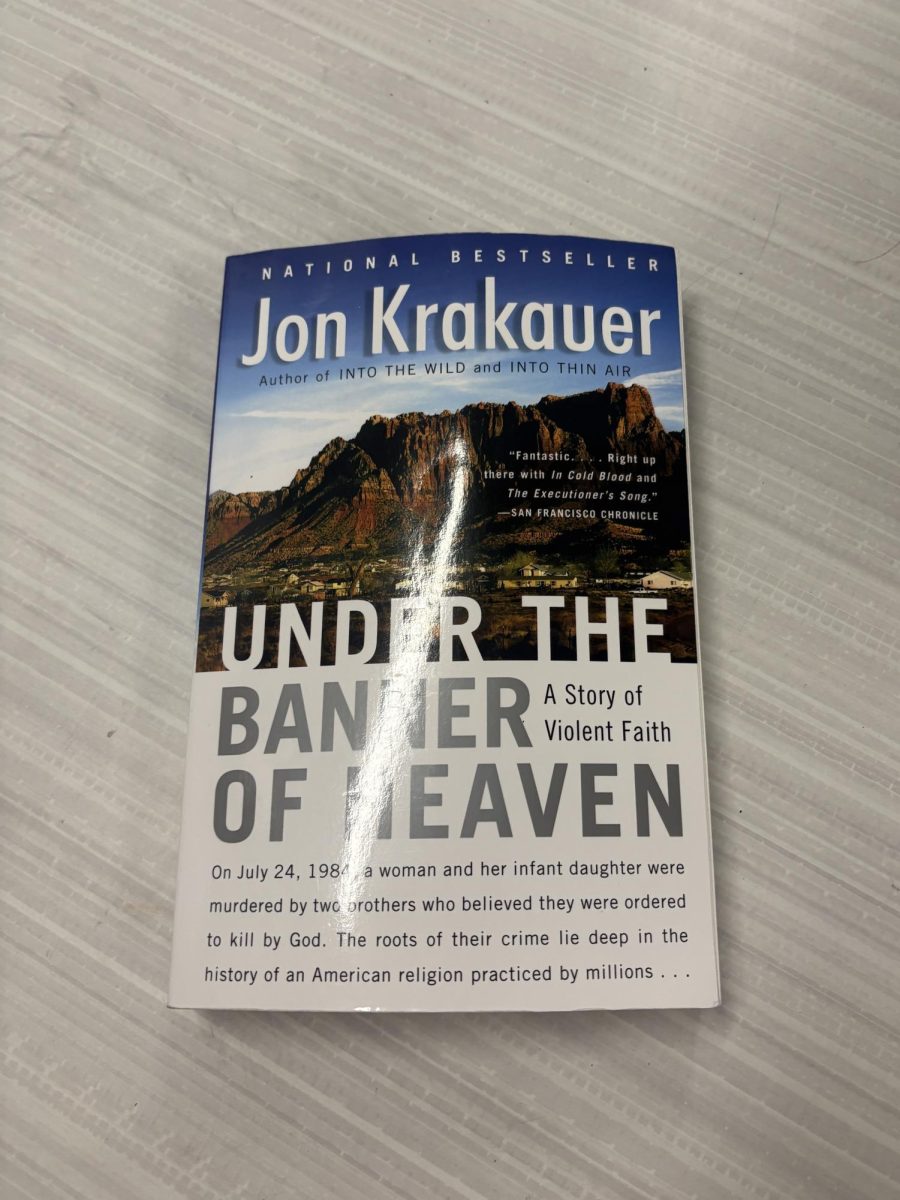
The book by John Krakauer, Under the Banner of Heaven, is an investigative and non-fiction piece written to explore the dangers in violent extremism within fundamentalist Mormonism and how it contrasts with conventional Latter-day Saint (LDS) beliefs. The book is based on a true story when in 1984, Brenda Lafferty and her infant daughter, Erica, were murdered by Brenda’s brother in laws, Ron and Dan Lafferty, who claimed they had instruction from God to commit the act. Krakauer’s approach to exploration begins by discussing the intense polygamy in LDS sects in Colorado City that straddles the border between Utah and Arizona. It observes the severe abuse committed upon sister-wives by their husbands. Kraukauer later moves into how Mormonism began by discussing how Joseph Smith created the religion. Kraukauer places emphasis on the notion that mainstream and modern Mormonism is separated from the isolated and patriarchal sect of fundamental Mormonism.
At the center of the book is the 1984 murder of Brenda Lafferty and her infant daughter committed by her brother in laws Dan and Ron Lafferty. The brothers claimed “divine revelation” as justification for the murders. Rather than treating the crime as insanity, Krakauer relates the crime back to a broader historical and theological idea with origins tied to the Church of Jesus Christ of Latter-day Saints. In the book, Krakauer includes moments of violence, hatred, and conflict through figures like founder Joseph Smith. This illustrates the complicated and complex teachings of the religion. By doing this, Kraukauer says that extremist actions are not disconnected from the faith, but rather represent a troubling interpretation of its teachings.
Krakauer’s approach to investigating this story moves through the Lafferty case and other events and ties them into the broad and deep history of Mormon fundamentalism. He does this by including various interviews, historical documents, and scripture from the Book of Mormon.
The book moves rather quickly, including swift transitions between stories that may be difficult to follow at times. It also can be hard to distinguish the ideas of the Mormon church that are mainstream or fundamentalist. His emphasis on violent or controversial aspects of the Mormon church and its history can, at times, create a screwed perception. On occasion, it can include bias and this may reinforce stereotypes directed at the Mormon church versus a fully balanced view from all sides. Either way, Krakauer’s book and point of view is not meant to represent the average practicing Mormon, but to examine how extreme religious beliefs can sometimes lead people to justify acts of violence.
Ultimately, Krakauer’s work is an example of how investigative journalism can uncover uncomfortable or hidden truths. By examining a true story and religious doctrine, he creates a piece that allows readers to think critically and emotionally, crafting beliefs and views that shape our world.
I highly recommend this book to anyone. Not only was it interesting to read, but Krakauer’s writing uses advanced vocabulary and sounds very intelligent. I’m a person who likes to find out why people believe what they do, so I personally find the practices and teachings of Mormonism very interesting because in many cases, they diverge from traditional American culture. This book is good if you have ever wondered about polygamy and Mormonism.